

Fifty years ago, on December 17, 1975, Virginia governor Mills E. Godwin stepped to the microphone in front of reporters. He announced an authorization from the state’s Health Department closing the James River from the Richmond fall line to the Chesapeake Bay “for the taking of fin fish.”
The ban included shellfish harvesting as well. The reason: contamination by Kepone, the brand name of the pesticide chlordecone. In his statement, the governor reassured Virginians that this was “a precautionary measure,” only in effect “until we are satisfied there is no hazard to public health.”1
This order followed the closure of Life Science Products in Hopewell in July, the facility that had manufactured Kepone under contract from nearby Allied Chemical. Health Department officials forced the facility to close after discovering workers suffering from various levels of Kepone poisoning, including tremors and neurological ailments.
Virginia found itself with a full-blown environmental disaster, the effects of which are still present fifty years later.
In my book, Poison Powder, I trace the history of this event and its legacy. I used sources including oral history interviews; newspapers; and legal, scientific, and government documents. I conducted the bulk of the interviews and gathered many of those documents while at the Library of Virginia as a Virginia Humanities research fellow. These sources showed how the Kepone disaster left its mark on Virginia and, as it turns out, other parts of the world as well.
Copy of Governor Godwin's press release and first order announcing the closure of the James River on December 17, 1975.
Virginia Department of Health, Office of the State Health Commissioner, Regulatory and Case Files, 1975–1997, Library of Virginia.
What is Kepone?
Kepone is the brand name for chlordecone: a powdery, white pesticide. Allied Chemical patented Kepone in 1952 and began commercial production in 1958. While some Kepone was used domestically as bait in ant and roach traps, the vast majority went overseas to control two major insects: the Colorado potato beetle and the banana root borer, or weevil. Records from Allied Chemical and government agencies revealed the results of laboratory tests as far back as the 1950s that indicated chlordecone was an endocrine disruptor and likely carcinogen, causing problems with the liver, eyes, and reproductive system. Further testing in the 1970s subsequently confirmed these findings.
Allied manufactured Kepone in several locations. Its main facility in Hopewell produced it on and off between 1966 and 1974. Allied also subcontracted with other producers, a process known as “tolling,” including Nease Chemical in State College, Pennsylvania, from 1959 to 1966, and Hooker Chemical from 1965 to 1967. Life Science Products contracted with Allied in 1974.
Life Science Products
Owning and operating Life Science were two former Allied Chemical executives, William Moore and Virgil Hundtofte. At different points, both men were responsible for Kepone production at Allied. In the 16 months before it was shut down, Life Science manufactured between 1.7 and 1.8 million pounds of Kepone, more than Allied had made in Hopewell in the previous eight years. At its peak in 1975, the plant produced about 6,000 pounds per day, operating around the clock. Chemical production was not labor intensive, and Life Science employed a fluctuating workforce of around 30–35 men at any one point.

Life Science Products building. The owners of Life Science converted a gas station and adjoining land into their plant for making Kepone.
(AP Photo by Mary Ann Carter)
The facility certainly earned its nickname as the “flour factory.” Inside Life Science, Kepone powder filled the air, and covered the equipment and the floor inside the production area. For a time in 1974, the powder left the plant and blew across the road into nearby businesses and homes. Workers didn’t use protective equipment, breathing in the dust and handling it with bare hands. It went home with them on their skin, inside their bodies, and on their clothes. Some of the men exhibited what their coworkers called the “Kepone shakes,” uncontrollable tremors, along with headaches and other ailments.
The contamination extended to the waterways as well. The city of Hopewell allowed Life Science to dump its waste directly into the sewer system. The initial discharges caused the sewage digesters to malfunction as they were unable to handle the pesticide. Life Science also produced liquid waste beyond what they normally discharged. To dispose of this excess, workers dumped it directly into sewer drains, into pits in nearby land, and in some cases at the city landfill. Much of the liquid eventually wound up in the James River.
The Role of Regulators
Even though Allied had manufactured Kepone for several years in Hopewell, state environmental regulators knew nothing about the pesticide. Regarding air pollution, it wasn’t among the substances air monitors in Hopewell and elsewhere across the state were set to detect. When Life Science began production, the Air Pollution Control Board only found out about the company after a leak of sodium trioxide, something for which the Air Board did monitor. An inspector, Jon Carroll, visited the facility and saw the dust-covered production area. As he noted later under questioning, Life Science “was a dusty, dirty operation…but then there are a lot of industries that are dusty and dirty.” He asked Hundtofte what they made there, and Hundtofte said a pesticide ingredient. “He allowed me to read the process description, and nowhere did it indicate it was a very toxic substance.”2 Health Department head James Kenley confirmed later that in none of the applications from Life Science did the company identify Kepone as toxic or hazardous.3 Carroll did require installation of equipment to capture the dust inside the plant. Yet Life Science failed to install the equipment until October, allowing Kepone dust to blow across Hopewell for several months.
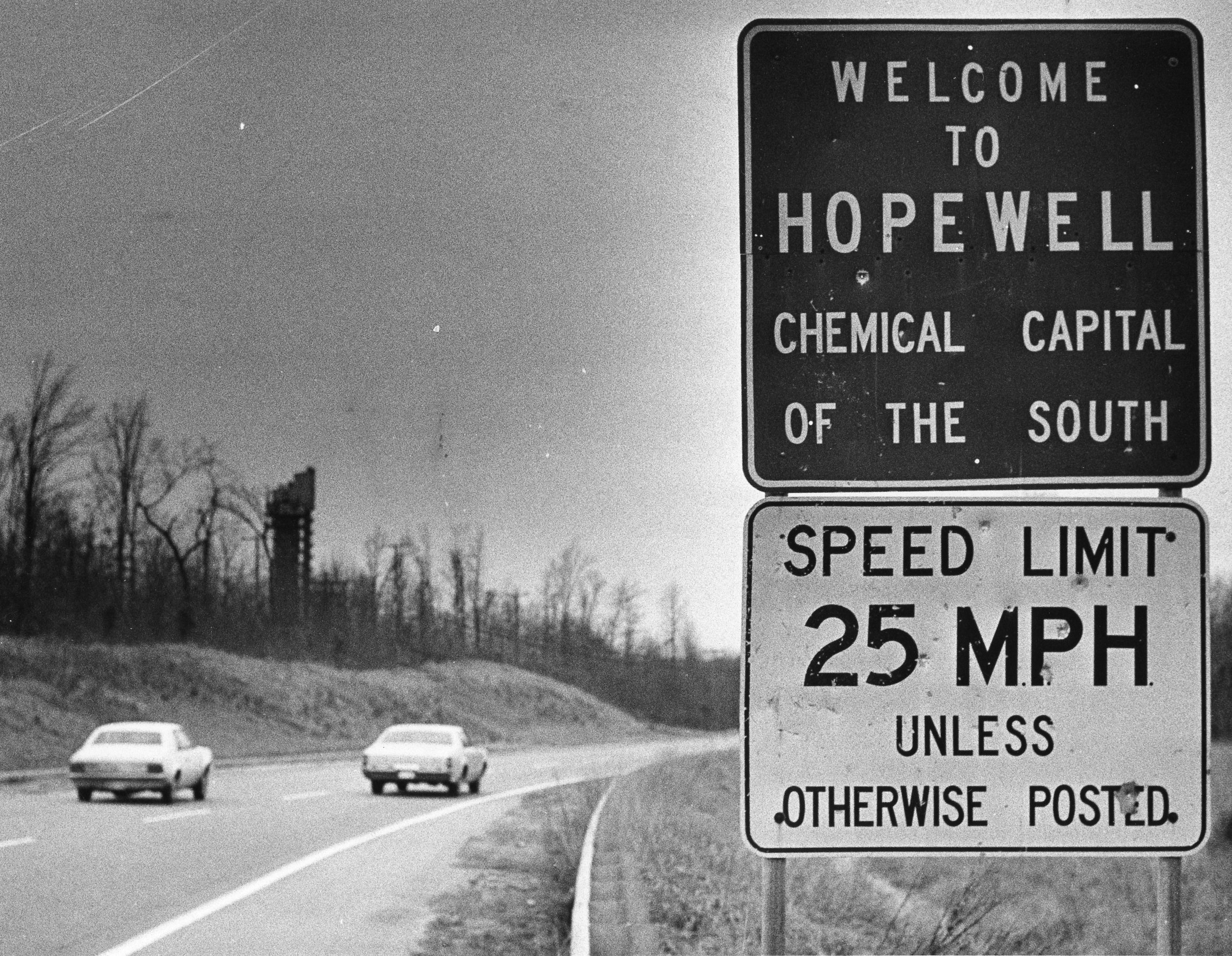
Carroll was right in the sense that dust and other particulates in the air seemed to be a regular occurrence in Hopewell. The city of some 25,000 residents called itself the “chemical capital of the South.” Allied Chemical, for example, regularly exceeded limits on emissions set by the federal Clean Air Act of 1970. In an interview, Hopewell native and local historian Jeanie LeNoir Langford expressed a common view in the city: “Yes, some people might say, well, Hopewell smells. Well, yes, it does, not nearly as much as it used to, but yes it does, but that’s the smell of money.”4
Life Science’s greatest environmental damage, however, was not to the air, but to the water. Since the company sent its waste directly into the sewer system, as opposed to waterways, neither the city of Hopewell nor Life Science filed for a pollution discharge permit with Virginia’s Water Control Board. Hence, the Water Control Board, like the Air Control Board, initially did not know of Life Science’s existence. As Kepone waste continued to enter the sewer system, sewer plant authorities worked in vain with Life Science to stop the contamination. At no point did the city notify the Water Control Board of the problem, however. The board only learned of it by chance through a conversation between one of the board’s engineers and the city’s sewer plant manager in September 1974. Following this, the Water Control Board began monitoring and pressured Life Science and the city of Hopewell to address the problem.

This sign, boasting about Hopewell’s chemical industry, greeted drivers as they entered the city along Route 10.
(Virginian-Pilot Archives/Tribune Content Agency).
The Water Control Board stopped short of shutting down the facility, however, and thousands of gallons of Kepone waste found its way into the James River.
The state’s Bureau of Industrial Hygiene, responsible for worker safety, also did not know of Life Science’s existence. They only knew of the company at the end of May 1975 after a worker at the Hopewell treatment plant was overcome by fumes from HCP, a toxic substance used to make Kepone. This led the bureau to schedule a full inspection of Life Science for late July, but the company’s closure came before that visit.

After extensive sampling and testing, the EPA published its results of the Kepone contamination in and around Hopewell on December 16, 1975.
Virginia Department of Health, Office of the State Health Commissioner, Regulatory and Case Files, 1975-1997, Library of Virginia.
Eventually, it was the Virginia Department of Health that was responsible for shutting down Life Science. And this arose because of one worker and his physician. In late June 1975, Dale Gilbert sought medical care for his uncontrollable shivering. Taking the advice of his wife, Gilbert met with local cardiologist Yinan Chou. Suspecting Kepone poisoning, Chou took a blood sample and sent it to the Centers for Disease Control for analysis. When the CDC called Chou, they were concerned that the sample had been compromised, because the amount of Kepone in Gilbert’s blood was so high. Chou sent Gilbert to the Medical College of Virginia (MCV) for hospitalization and more testing. Meanwhile, the CDC contacted Dr. Robert Jackson at the state Health Department to report the results. Jackson, too, had never heard of Kepone. He then arranged a visit on July 23 to Life Science to see the production area and examine workers coming off their shift. He quickly determined that many of the men suffered from Kepone poisoning and had them sent to MCV. When he visited the plant, Jackson recalled that he “waded through puddles of Kepone-contaminated water in a makeshift factory filled with Kepone-caked machinery.”5 The dust in the drying room “was quite thick” and the workers he saw confirmed that they “very seldom used any kind of protection.”6 Jackson returned to Life Science the next day, and Hundtofte agreed to cease operations before the Health Department issued an order to do so.
At this point, various federal agencies joined with the Virginia Health Department for further investigations. Out of 149 workers, Jackson and his colleagues identified 76 workers with Kepone poisoning, with 29 of those hospitalized for treatment. On December 16, the Environmental Protection Agency published its report showing widespread Kepone contamination in the soils surrounding Life Science, in the sediments of Bailey Creek in Hopewell, and the sediments and marine life of the James River.7 The next day Governor Godwin announced the fishing ban.
Legal Cases and Legislation
Kepone made news throughout 1976 as politicians conducted hearings and regulators pursued investigations into the causes of, and remedies for, the environmental and occupational disaster. Both civil and criminal litigation went forward as well.
Poisoned workers filed civil suits in federal court against Allied Chemical for failing to provide adequate warnings to Life Science and its workers on the toxicity of Kepone. Various individuals and companies in the seafood industry also filed federal civil lawsuits against Allied, as the fishing ban decimated their way of life. There were some 250 seafood industry claimants seeking damages that reached $16 million.
Surprising evidence emerged that led federal prosecutors to pursue litigation against Allied. The Water Control Board maintained a frozen fish “library” and testing of fish taken from the James River in the early 1970s showed concentrations of Kepone.
In addition, federal prosecutors came upon documents that showed Hundtofte, when he was with Allied, and other Hopewell executives violated federal environmental laws by dumping Kepone waste into the water. Armed with these and other pieces of evidence, in May 1976 a grand jury handed down sweeping criminal indictments against Allied Chemical and key employees including Hundtofte and Moore, as well as the city of Hopewell.
Adjudicating these cases was Judge Robert Merhige. Allied settled out of court with the workers and the fishing industry. For the workers, medical intervention helped them alleviate the pain and shaking, although long term effects for them remain unclear. Merhige dismissed some charges against Allied, but calling the Kepone disaster a “crime against every citizen,” he imposed a $13.24 million penalty against the company for violating federal environmental laws. It was the maximum amount allowed and the largest against a polluter up until that time.8

The Richmond Times-Dispatch announced the $13.26 million fine against Allied on Oct. 6, 1976.
He also suggested that if Allied made efforts to address the problems caused by Kepone, he would be open to reducing the fine, but not the total amount owed. In a February 1977 agreement, Merhige reduced Allied’s fine to $5 million in exchange for using $8 million to establish the Virginia Environmental Endowment (VEE), which still exists today.
The state of Virginia filed its own lawsuits against Allied. Those were also settled in 1977 with Allied agreeing to additional payments to the state and Hopewell for cleanup and disposal of Kepone waste.

A sign indicates one of the places in Hopewell that contains buried Kepone waste. This is located at the now defunct Hopewell sewage treatment plant.
(Photograph by Greg Wilson)
In the end, the Kepone incident cost Allied Chemical $30 million. The company buried Kepone waste on its property near the James River, and the city of Hopewell buried Life Science waste at its former sewage treatment site. Allied sent its remaining Kepone stocks to Germany for burial in a former salt mine that had been converted into a hazardous waste disposal site. In 1978 the Environmental Protection Agency estimated that 20,000 to 40,000 pounds of Kepone had settled into the bottom of the James, where it remains today buried under a few feet of sediment.
Merhige imposed a fine of $3.8 million on Life Science for 154 pollution charges. He also fined the two owners of Life Science, William P. Moore Jr. and Virgil A. Hundtofte, $25,000 each and placed them on five years’ probation. Merhige also placed the city of Hopewell on probation for allowing Life Science to dump Kepone-laden waste into the sewer system, thereby contaminating the James River.
The fishing ban proved deeply contentious. The seafood industry fought against it, and as measurable levels of Kepone in seafood slowly dropped, subsequent advisories lifted parts of the ban. Eventually, Virginia lifted the ban completely in 1988. Yet state fishing warnings still caution anglers about Kepone, along with other toxins like PCBs and mercury.
The Kepone disaster helped spur the creation of new state and federal legislation. In March 1976, Virginia approved the Toxic Substances Information Act. Then in October, President Gerald Ford signed the federal Toxic Substances Control Act into law. At OSHA, Kepone pushed the agency to focus equally on worker health as well as safety and set new standards for Virginia and all states related to occupational health and safety.9 Later, the Clean Water Act amendments of 1977 addressed control of toxic substances.
Beyond Virginia
The public health and legal issues associated with Kepone went beyond Hopewell and Virginia. On the islands of Guadeloupe and Martinique, the heavy use of chlordecone against the banana weevil poisoned the land, drinking water, and fishing stocks, creating a massive, still ongoing public health crisis. The Hopewell case and the experience in the French West Indies led the United Nations to ban chlordecone in 2009 under the provisions of the Stockholm Convention on persistent organic pollutants (POPs) that also includes notable pesticides like DDT, Aldrin, Dieldrin, and Kepone’s cousin, Mirex.
The fishing ban from fifty years ago was just one small part of a more complex and wide-ranging Kepone story. It spanned from Virginia to Europe and the Caribbean. It stemmed from a makeshift, inconspicuous factory, making a pesticide no one knew about, in a small industrial city. And it all started with a doctor’s visit.
-Gregory Wilson
Footnotes
[1] “Governor’s Press Release,” December 17, 1975, “State Board of Health Emergency Rules – Closing of the James River, 1975” folder, box 8, Regulatory Case Files of the Virginia Department of Health, 1948-2001, Accession 45167, Library of Virginia.
[2] Nicholas Brown, “Plant Wasn’t Inspected,” Richmond Times-Dispatch, January 18, 1976, A-19.
[3] “Chronology of Events Relevant to Production of Kepone By Life Science Products, Inc.'” folder 1, box 8, Herbert H. Bateman State Senate Records, Mss. 83 B31, Special Collections Research Center, William & Mary Libraries.
[4] Jeanie LeNoir Langford interview with author.
[5] Nicholas Brown, “Kepone,” Richmond Times-Dispatch, July 18, 1976, G-1.
[6] Kepone Contamination: Hearings Before the Subcommittee on Agricultural Research and General Legislation of the Committee on Agriculture and Forestry, U.S. Senate, 94th Cong., 2nd session, 1976, 71.
[7] “Fact Sheet on Kepone Levels Found in Environmental Samples from the Hopewell, VA Area,” December 16, 1975, “State Board of Health Emergency Rules – Closing of the James River, 1975” folder, box 8, Regulatory Case Files of the Virginia Department of Health, 1948-2001, Accession 45167,, Library of Virginia.
[8] Dale Eisman, “$13.24 Million Allied Fine Largest Ever for Pollution,” Richmond Times-Dispatch, October 6, 1976, 1.
[9] Richard E. Gordon, “Kepone Helped Bring Passage of New Laws,” Richmond Times-Dispatch, June 9, 1985, D-1.


