

Editor’s Note: This blog post contains information from the Library of Virginia’s 2001–2002 exhibition, “Taking Office: Inaugurations of Virginia’s Governors,” curated by Barbara Batson and Brent Tarter, and from the online exhibition “Taking Office: Inaugurations of Virginia’s Governors, 1942–2010,” curated by Roger Christman.
On January 17, 2026, Virginia will make history when the Commonwealth’s next governor, lieutenant governor, and attorney general are inaugurated. The new governor and her colleagues will take an oath of office to support and defend the state’s constitution and to execute the laws of the Commonwealth in a ceremony that has changed over the 250 years since Virginia’s first elected governor was inaugurated.
Colonial Virginia
At the colony’s beginning, the chief executive of Virginia was the president of the Council, whose members had been named by the king. With the appointment of Sir Thomas Gates in 1610, the Virginia Company of London began naming the governor. In the governor’s absence, a deputy performed the functions of his office. Between 1624 and 1776 Virginia’s governors received their appointments from the British Crown. The king or queen appointed and authorized the governor to administer the colony according to the instructions sent by the Crown and its ministers. The new governor or his deputy, the lieutenant governor, took the oath of office in solemn ceremonies before members of the governor’s Council, most often in the Council Chamber in the colony’s Capitol.
The General Assembly Elects
After Virginia declared independence from Great Britain and adopted its first state constitution in 1776, the General Assembly elected a governor each year. No person could be elected governor for more than three successive terms or be elected again until after a period of four years. Virginia’s governor acted only with the cooperation of the executive Council that the assembly also elected. The inauguration ceremony was a quiet event. A justice of the peace administered the oath of office, and the governor signed an affidavit that he had taken the oath. No speeches, no parades, no public ceremony.

Patrick Henry was the first governor of the Commonwealth of Virginia. He took office on July 6, 1776.
State Art Collection, Library of Virginia.
Popular Election
Under the Virginia Constitution of 1851, the General Assembly surrendered its power to elect the governor to the voters. Under that constitution, all white men age twenty-one and older were eligible to vote. That constitution limited governors to a four-year term with no eligibility for immediate reelection – a restriction that continues to the present day. Mills E. Godwin Jr. is the only person to twice win popular election as governor, the first time in 1965 as a Democrat and again in 1973 as a Republican.
Governors continued taking the oath of office in simple ceremonies at the Capitol, which was sometimes followed with receiving guests at the Executive Mansion. In his message to the General Assembly on January 1, 1856, Governor Henry A. Wise stated that “I have appeared at the executive chamber in the capitol, taken the oaths prescribed by law, and have entered upon the duties of the office.” The assembly was in session on that day, but at the invitation of the new governor, it adjourned and members joined a large crowd at the Executive Mansion for an afternoon reception.

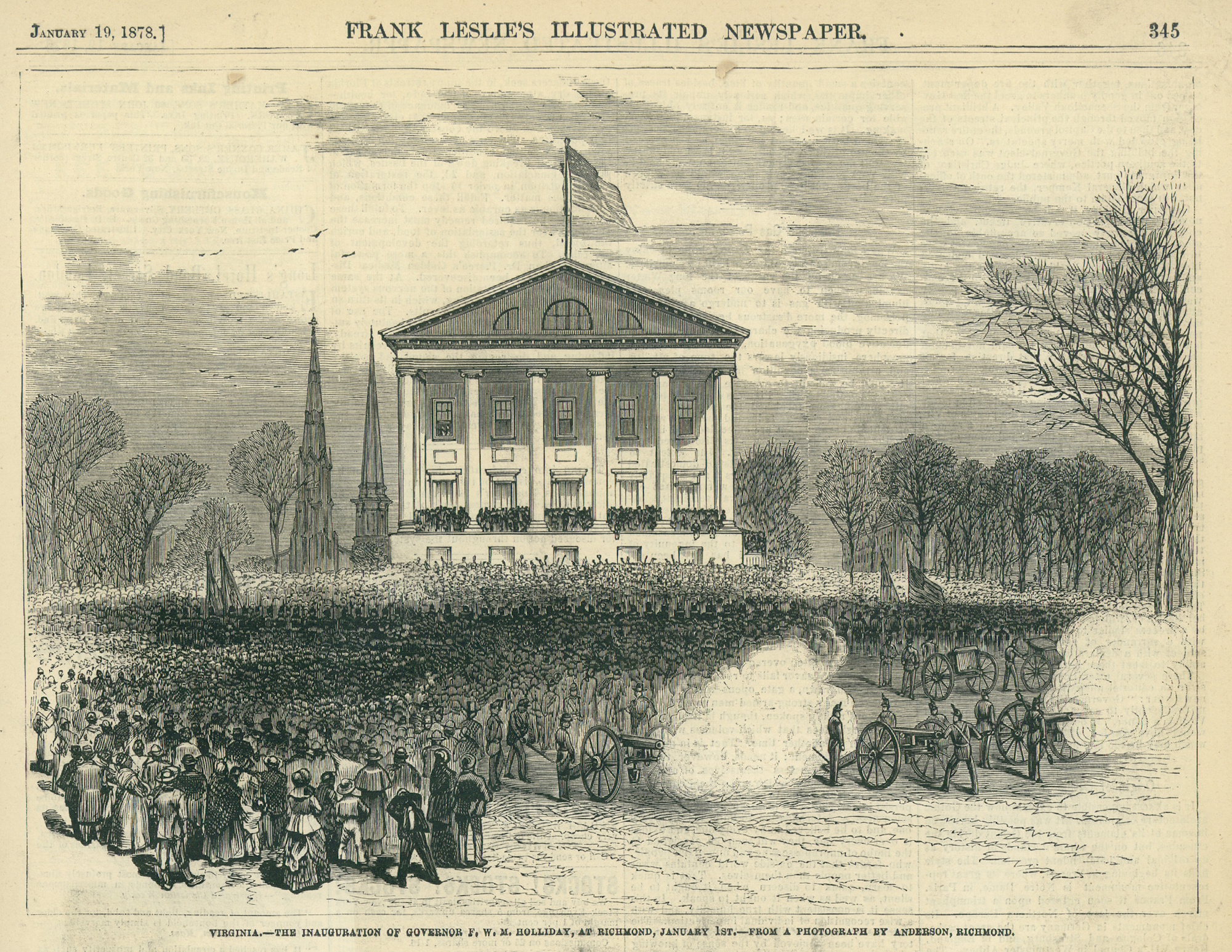
This wood engraving published in Frank Leslie's Illustrated Newspaper on January 19, 1878, shows the large crowd that attended F. W. M. Holliday's inauguration, but not everyone was impressed. A man who voted for Holliday complained in the Richmond Daily Dispatch about ``the ridiculous show and pageantry which has been made over the inauguration.``
Special Collections, Library of Virginia.
In 1864, William “Extra Billy” Smith took office in a public ceremony—possibly the first to do so—before “a large audience of spectators, including many ladies,” as reported by the Richmond Whig. He delivered a forty-five-minute speech before taking the oath of office in the Hall of the House of Delegates on the first day of January.
Frederick W. M. Holliday had very different ideas about his inauguration on January 1, 1878. The Richmond Daily Dispatch described the event as “an imposing pageant” with “interesting and unusual ceremonies.” Under bright skies, the gubernatorial party was escorted from Main Street to Capitol Square in a circuitous route that snaked through downtown Richmond. Among those in the procession were the Richmond fire department, Richmond police, and military units, including the Band and Drum Corps from Holliday’s hometown, Winchester. Holliday and his colleagues entered the Senate chamber for the administration of the oaths of office before Governor Holliday delivered his inaugural speech from the south portico of the Capitol to a crowd estimated at ten or twelve thousand. Holliday’s successors reverted to quiet ceremonies without large public displays, although Fitzhugh Lee’s 1886 inauguration concluded with an inaugural ball.
Public Celebration
Changes came to gubernatorial inaugurations in the twentieth century. Parades became standard practice, photographs of inaugurations appeared in the newspapers, and inaugural addresses could be heard over radio and later watched on television. In 1926, Harry Flood Byrd was the first to use radio (WRVA) and an audio system to broadcast his inaugural address. In 1946, William M. Tuck’s inauguration was the first to be televised in the Commonwealth.
The 1902 Virginia Constitution changed the inauguration date from January 1 to February 1. Every governor since Andrew Jackson Montague in 1902 has taken office during a joint session of the General Assembly. The amended Constitution of 1928 changed the date to the third Wednesday in January to move it closer to the opening of the General Assembly. It also specified that gubernatorial terms expired the day before their successor was inaugurated, leaving Virginia’s government without an executive administration for about half a day each inaugural year. An amendment ratified in 1956 eliminated the discrepancy and moved the date to the Saturday after the second Wednesday in January.

Henry C. Stuart was the first Virginia governor to ride in an automobile in his hour-long inaugural parade before 50,000 people.
Richmond Times Dispatch, February 3, 1914.
In 1914, Henry Carter Stuart expanded the public celebration. For the first time, a platform was constructed over the Capitol’s south portico steps to seat 500 people, including members of the General Assembly and invited guests. Stuart rode in an automobile in the parade, which was followed by his inaugural address and a procession of troops before the stand. Since 1914, inaugurations have occurred outdoors, weather permitting. They have also included a parade except for the 1942 inauguration of Colgate Whitehead Darden who, in deference to the United States’ entry in World War II six weeks before, dispensed with most of the ceremony.
Although most inaugurations occur on the south portico of the Capitol, there have been exceptions. In 1941, Governor-elect Darden asked that his inauguration be held on the north side of the Capitol, which prompted the clerk of the House of Delegates to point out that the north side was “less desirable for weather conditions.” The inauguration occurred on the south portico. In 1982 Charles S. Robb moved his inauguration to the north side of the Capitol to allow more visitors an unobstructed view of the ceremony. In 1998, the ceremony moved back to the south portico for the inauguration of James S. Gilmore, where it has remained other than in 2006 when the colonial capital of Williamsburg hosted the gubernatorial inauguration of Timothy M. Kaine as a result of ongoing renovations in the Capitol.

Plans for the inauguration begin shortly after the November general election. Workers construct a platform for the administration of the oath of office on the south portico of the Capitol and bleachers for spectators. This sketch outlined the seating arrangements for William Tuck's inauguration in 1946.
William M. Tuck Executive Papers, 1946–1950, Accession 24026, Library of Virginia.
Many of the activities associated with gubernatorial inaugurations today had been established by the 1930s. The retiring governor drove to the governor-elect’s hotel and escorted the new governor to Capitol Square. The new governor entered a joint meeting of the two houses of the General Assembly in the chamber of the House of Delegates. Then the entire legislature and invited guests moved to the Capitol where the governor was sworn in and delivered his inaugural address. A formal reception followed either in the Capitol or in the governor’s mansion.
Increasingly, inaugural committees planned the celebration. In 1970, A. Linwood Holton added two events: on the morning of the inauguration he attended church and in the evening his supporters held an inaugural ball. Because the lieutenant governor and the attorney general were not always members of the governor’s political party, occasionally there were minority party inaugural balls.


Today, events associated with gubernatorial inaugurations include a church service, a parade, the swearing-in, receptions, and balls. As campaigns have increased in cost, inaugural committees have turned to marketing to use inaugural balls and receptions as a means to raise funds.
Making History
On January 13, 1990, Lawrence Douglas Wilder, a grandson of enslaved people, took the oath of office as the nation’s first elected Black governor. He had already made history in 1985 when he became the first Black Virginian elected to statewide office and in 1986 when he was sworn in as lieutenant governor. Mary Sue Terry, the first woman to win statewide office in Virginia as attorney general in 1985, also took the oath of office for her second term in 1990. In 2022, Winsome Earle-Sears became the first woman elected lieutenant governor, and Jason Miyares was the first Hispanic person elected to statewide office in Virginia.

Lieutenant Governor Don Beyer, Governor Doug Wilder, and Attorney General Mary Sue Terry at the historic 1990 inauguration of the first African American elected governor in Virginia and the United States.
Governor Lawrence Douglas Wilder, Photographs, 1989–1993, Accession 35539, Library of Virginia.

With Abigail Spanberger's historic election in 2025, Virginia will inaugurate its first female governor.
Richmond Times-Dispatch, November 5, 2025.
Almost 250 years after Patrick Henry took his oath of office as the state of Virginia’s first governor, a woman will do so. On January 17, 2026, Virginians will witness the inauguration of the Commonwealth’s first woman elected governor, Abigail Spanberger, as well as the first Muslim lieutenant governor, Ghazala Hashmi, and the first Black attorney general, Jay Jones. While a new governor takes office every four years, the traditions and ceremonies of that day symbolize continuity in the transfer of power in Virginia.
Visit the Capitol after January 19, 2026, to see the Library’s panel exhibition, “Taking Office,” in the visitor center.
— Barbara Batson, Roger Christman, and Mari Julienne
Related Links
Taking Office: Inauguratiotahns of Virginia’s Governors, 1942-2010 (Google Arts & Culture exhibition)
Taking Office: Inaugurations of Virginia’s Governors, 1942–2010 (The UncommonWealth)


