

In his diary on July 18, 1709, William Byrd of Westover remarked, “Tom returned from Falling Creek and brought me word all was well there and that the coaler found the coal mine very good and sufficient to furnish several generations.” Coal has long been a significant part of Virginia’s economy. Beginning in 1750, when coal was first shipped from Chesterfield County’s Midlothian mines to Philadelphia, Virginia’s coal attracted wider market attention. With the opening of the coalfields in Southwest Virginia late in the 19th century, Virginia coal fueled coke ovens supplying the steel industry. By 1948 Virginia was producing almost 20 million tons of bituminous coal a year and ranked seventh in coal-producing states.
The Coalfields
The success of Southwest Virginia’s coalfields—lying in Buchanan, Dickenson, Lee, Russell, Scott, Tazewell, and Wise Counties—is inexorably linked to the expansion of railroads and to northern capital. After the Civil War, rail companies expanded westward as entrepreneurs and industrialists opened coal seams in Virginia’s southwestern region. Norfolk and Western shipped its first coal from the Pocahontas Coalfield in 1883 and quickly developed lines through Tazewell to Norton. The Louisville and Nashville built into Norton and the Wise County coalfields by the 1890s. By 1900, companies developed lines that delivered coal from Southwest Virginia to piers at Hampton for shipment to both domestic and international markets. Southwest Virginia coalfields supplied high-grade coking coal to fuel the steel industry, as well as steam coal for industrial and domestic use. The boom economy created by mining in the early 1900s faltered during the Great Depression but recovered during World War II. By the 1950s, many of Virginia’s veins, which had begun operations more than fifty years earlier, were mined out.

First train into Pocahontas, March 12, 1883.
Tazewell County Public Library Photograph Collection. Library of Virginia.

Coke ovens near Norton, Virginia, circa 1930.
Virginia State Chamber of Commerce Photograph Collection.
Beginning in the 1880s, investors in New York and Philadelphia formed mining companies that purchased large tracts of land or negotiated mineral and timber rights in these rural counties. Before the boom ended in the 1920s, as many as 125 coal camps, or company towns, thrived in Southwest Virginia. The coal camps brought together, often for the first time, miners of different cultures and nationalities. To meet labor demands, mining and railroad companies advertised for and brought emigrants not only from other states, but also from Italy, Hungary, and Poland.
Life in the Coal Camps
What was daily life like in a Southwest Virginia coal town? Photographs and company annual reports and financial records are valuable sources of information but leave silent the voices and memories of miners and their families. During the Great Depression, the Virginia Writer’s Project, a state-sponsored program of the Federal Writers’ Project, an agency of the Work Projects Administration (WPA), conducted interviews about occupations and experiences in Virginia’s urban and rural areas. These oral histories came to be known as the WPA Life Histories and despite some flaws, they are a valuable window into the past. The interviews of people who lived in the coal towns of Southwest Virginia, such as A. L. Parrish and George and Celia Brown, attest to the dangers of mining and the hardships endured by the families in the coal camps.

Dorchester Coal Camp Baseball Team, 1909.
Image courtesy of Virginia State Parks.
Older men and women who were interviewed frequently lamented their lack of education and stressed the need for their children to have better educational opportunities. Mining coal was seasonal; demand fell during the summer months and miners’ families gardened and worked at other jobs to make ends meet. The interviews also record the changing relationship among miners, their families, and the coal companies.
Company Towns
Naming a coal town was the prerogative of the operator. Stonega Coke & Coal Company named its first coal camp, established in 1896, Stonega, a combination of Stone and Gap. Camps were named for people (Imdoben, 1910) or for villages in Great Britain (Dunbar, 1917). Whimsy occasionally surfaced; according to local tradition the coal town of Derby, founded in 1923, was named by its Philadelphia company officials who traveled through the area on their way to the Kentucky Derby. The origin of Keokee, in Lee County, built in 1910, is a mystery; it may be a Cherokee word or the name of the wife of one of the company officials.

Pocahontas Consolidated Collieries Company Commissary and General Offices.
Tazewell County Public Library Photograph Collection. Library of Virginia

Coal-laden railroad cars passing through the Premier Coal Company camp at Red Ash, undated.
Tazewell County Public Library Photograph Collection. Library of Virginia.
Characteristic of coal towns was the outsized influence of the company. Companies built, owned, and operated hospitals, hotels, recreation halls, schools, and stores for miners and their families. They paid for medical personnel and teachers. Company-run commissaries, also known as company stores, carried necessities and amenities such as washing machines, radios, and refrigerators. These items were available for purchase primarily on credit or through the use of company scrip. Scrip was token or paper with monetary value issued by the companies as an advance on future wages. It could only be redeemed in the company’s town at the company’s stores, thus simply returning the wages to the coal company. To make ends meet, families often tended gardens to “put up” or can goods for later use and women sold butter and eggs.
Some companies sponsored garden awards and gave chocolate and fruit to miners’ children at Christmas. Coal companies encouraged sports to fill leisure time, and camp rivalries could be intense. Miners also sought other recreation in their off hours. At Roda (built in 1902), miners formed a band, and, in Stonega, the Stonega Coke and Coal Company sponsored an African American quartet. Coal companies also made land available for both Catholic and Protestant church structures for worship. Miners and their families also enjoyed their leisure time by visiting neighbors, going to the movies, having card parties, and picnicking.

Boissevain Tipple, about 1908.
Tazewell County Public Library Photograph Collection. Library of Virginia.

House and privies. Raven Red Ash Coal Company, No. 2 Mine, Raven, Tazewell County, Virginia.
Dept. of the Interior, Solid Fuels Administration for War, Photographs of the Medical Survey of the Bituminous Coal Industry, 1946–1947. National Archives and Records Administration. Local ID: 245-MS-2040L
The earliest coal camps often consisted of boarding houses for the mostly unmarried male miners; duplexes and single-family houses were more common after the 1910s when companies actively recruited a more stable workforce of married men with families. Squeezed between mountains and stretched out along creeks, the camps often were divided along class, ethnic, and racial lines. Mining town sections carried names such as “Pink Town” (native white), “Colored Hill” (African American), “Hunk Town” (Eastern European), and “Quality Hill” (company officials). Even after the establishment of permanent housing, coal towns often lacked adequate sewerage and water facilities.
Labor Relations
Unlike the coalfields in West Virginia and Kentucky, Virginia’s coal towns did not experience large scale labor unrest, but labor organizer Mother Jones did organize her first coalfield strike in Norton (Dietz Mine) in 1891. She was back again in Norton to organize “her boys” against the Stonega Coal Company in 1901. By the 1930s, the United Mine Workers of America (UMWA) had organized the central Appalachian coalfields resulting in higher wages and better working conditions.

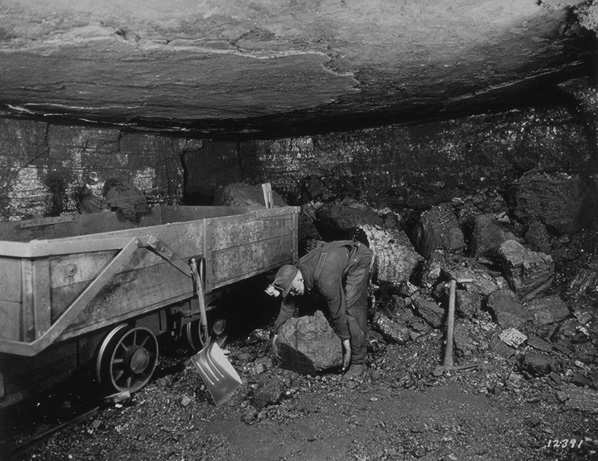
The coal is then loaded by hand into the mine cars, circa 1939
1939 World's Fair Photograph Collection. Library of Virginia.

Loading coal, undated.
Tazewell County Public Library Photograph Collection. Library of Virginia.
After World War II, the passage of Virginia’s so-called right-to-work laws, coupled with coal’s market share losses to gas and oil and the increased use of mechanization in mining, meant a weakened position for miners. The ensuing decades saw fewer and fewer jobs for Southwest Virginia miners. A rebound for the industry in the 1980s brought back some jobs to the southwestern fields though with far lower pay, fewer safety protections, and decreased benefits. By decades end, the elimination of retiree healthcare benefits resulted in a multi-state strike against the Pittston Coal Company, the last major labor strike in the Virginia coalfields.
Virginia’s Coal Towns Today
Although the Great Depression and development of alternative fuels forced many mines to close and many families to leave, some coal towns survived. Today several communities, such as Stonega and Derby, have been designated as historic districts to preserve their architectural history. Researchers have recorded buildings in Clinchport, Scott County, for the Historic American Buildings Survey (HABS). HABS researchers also surveyed the mining camp of Trammel, in Dickenson County, which was built in 1917. Oral history projects at East Tennessee State University, Radford University, and the University of Virginia at Wise have preserved memories of current and former residents.
Bluefield’s Eastern Regional Coal Archives, although focused on West Virginia, collects materials relating to the region’s rich coal history. A grassroots method of preserving the history of Virginia’s coal camps developed with the advent of the internet. People who grew up in the camps have created websites and established social media groups to share memories of coal camp life. Additionally, the Commonwealth’s coal mining history is preserved through the Virginia Coal Heritage Trail scenic byway, which includes a stop in Big Stone Gap (Wise County), home of the Southwest Virginia Museum.


