

I am a relatively new hire at the Library of Virginia, having joined in January of this year as the coordinator of a VA250-funded project, “Ideas in Action: Virginians Petition Their Government, 1776-1786.” One of my roles is to create a bridge between our Revolutionary-era collections and local communities. Along with other colleagues, I get the fun of sharing digital copies of original documents and helping residents across the Commonwealth to discover the 250-year-old stories that originated in their own communities.
The Virginia Legislative Petitions collection is central to the “Ideas in Action” project. These petitions were the principal means by which Virginians of all backgrounds communicated with their state representatives to ask them to address matters of personal or community importance. And the reason I love petitions is that they are such wonderful windows into individuals’ and communities’ stories. As researchers — and as story lovers — we can use these documents to trace those threads that most interest us about people, places, and life in the Revolutionary era.
With Peter Francisco Day looming (we celebrated yesterday!), I was asked if I wanted to look at his Revolutionary War record to see what stood out, and so I turned to the petitions he wrote to the legislature about his service. And there I found examples of two different story threads that might trace through these documents: the story of his military service, and a story of his horse.

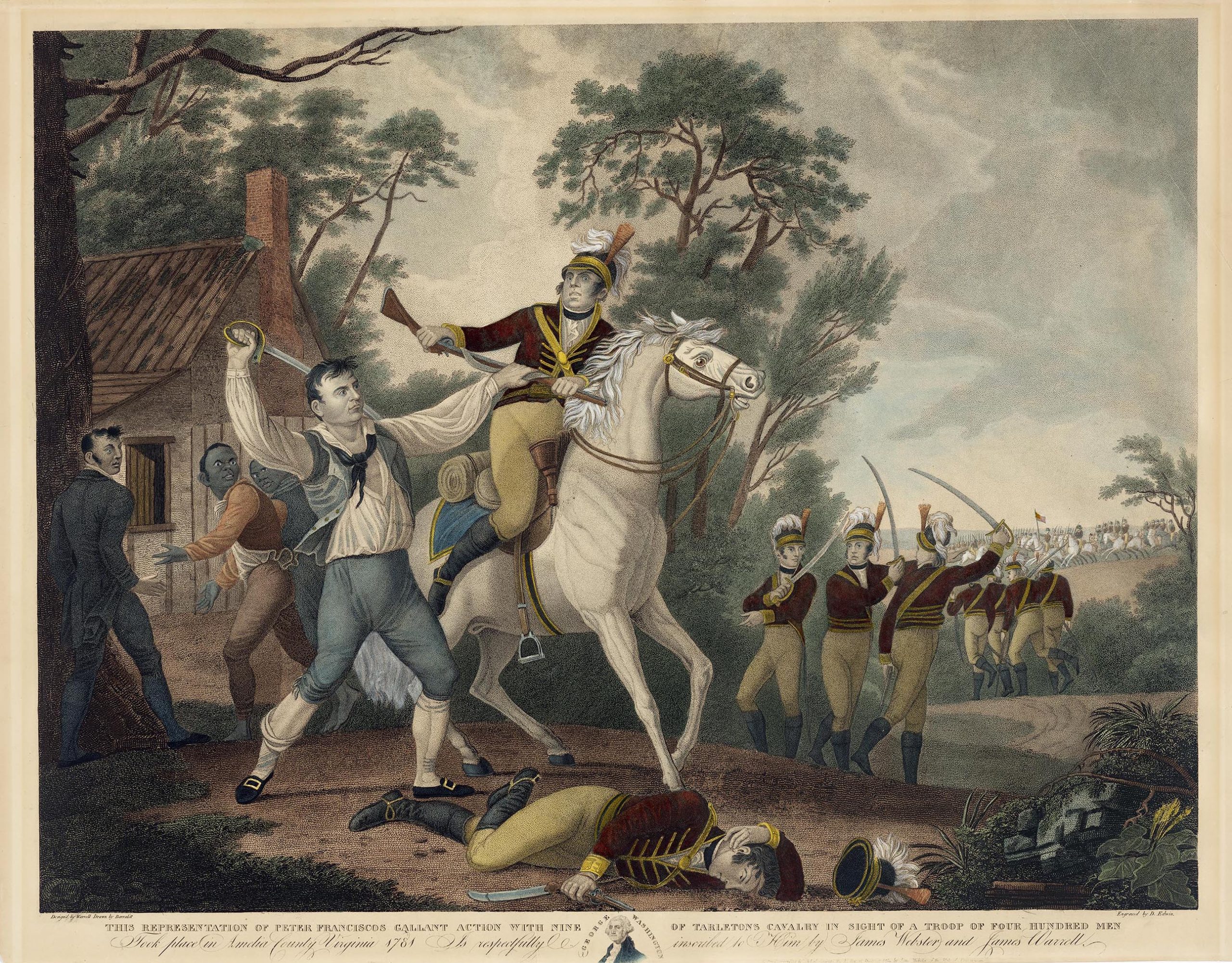
``Peter Francisco's Gallant Action with Nine of Tarleton's Cavalry in Sight of a Troop of Four Hundred Men. :Took place in Amelia County, Virginia, 1781.``
Lithograph drawn by August Kollner after the 1814 copper engraving by Webster and Worral.
But first, for those who are not familiar with Peter Francisco, some context: Peter Francisco was a Virginian of great renown, having served in the Continental Army and Virginia militia during the Revolution and seeing action in significant battles in the north and south including those at Brandywine, Monmouth, Stony Point, and Guilford Courthouse. Tradition says he was found abandoned as a five-year-old on the docks at City Point (now Hopewell) in Virginia in 1765 and ultimately taken in by and indentured to judge Anthony Winston of Buckingham County. After joining the 10th Virginia Regiment in 1776 as a 16-year-old, his massive size and strength — he was reputed to be six feet six inches tall and weigh more than 260 pounds — made him a standout soldier. He has subsequently been lauded as the Virginia Giant, George Washington’s One-Man Army, and “perhaps the most famous private soldier of the Revolutionary War.” He is the subject of poetry, song, and storybook. Virginia, along with Massachusetts, New Jersey, and Rhode Island, officially celebrates Peter Francisco Day annually on March 15, the anniversary of the 1781 Battle of Guilford Courthouse in North Carolina.
Peter Francisco, like many Virginia soldiers, petitioned the Virginia legislature in the years following the Revolution seeking various kinds of monetary recognition for his service. He wrote first in 1784, then again in 1790, and a third time as a much older man in 1821. In broad form, these petitions lay out the story of his service and conclude by asking the legislature to provide some form of financial support due to his sacrifices.
As we’ll explore below, the three petitions provide information about his military exploits, which can be of real interest to the military historian or the Daughters of the American Revolution member. But they also offer up a different, related story at a kind of unusual angle, about a man who, more than compensation for any other sacrifice, wanted repayment for his horse who died during the war. That equine focus struck me as interesting, so I wanted to trace that as well.
Let’s pull on both threads through all three petitions:
Petition of November 1784
In his first petition in 1784, Peter Francisco didn’t provide very many details of his military service, principally noting to the legislature that “he most chearfully engag’d as a volunteer at the commencement of the war and continued in the service of the united States for the term of three years” and then again later in the war that “at the alarming crises when Lord Cornwallis invaded this State he furnish’d himself at his own expence with a valuable Horse & other necessary accutrements for a dragoon and enter’d [the cavalry] as a volunteer.” He concluded by writing that he had “neither reciev’d money, Cloathing, or any kind of compensation whatever” for that service but hoped that the legislature might give him “that releif” that his hardships “entitle him to.”
What military details can we extract from this first petition?
- Peter Francisco volunteered at the commencement of the war in the service of the United States for three years
- He served under the command of George Washington in the northern states
- He received three wounds
- He volunteered again, this time as a dragoon, around the time Cornwallis invaded Virginia in spring 1781; however, because he also indicated that he fought at Guilford Courthouse, which was in March 1781, he must have joined up prior to that

Peter Francisco Petition, November 22, 1784.
Buckingham, Legislative Petitions of the General Assembly, 1776-1865, Accession Number 36121, Box 41, Folder 21
- He served under “General Lawson” (presumably Robert Lawson) and with “Colo Washingtons Legionary Corps” (presumably William Washington)
And what about the horse?
- Here we learn only that at the time of his 1781-timeframe reenlistment, he furnished himself at his own expense with “a valuable Horse”
In a later post we can walk through the intricacies of the legislative petition process from the point of view of the legislature, but right now we might simply observe that after the House received his petition on November 22, 1784, and referred it to the House’s Committee on Claims, a memorandum on his petition from Bolling Stark of the office of the Auditor of Public Accounts dated two days later noted that Francisco had in fact never applied to that office for a settlement and added that the auditors were not empowered to make him any sort of allowance “as he is not possessed of any certificate which fixes the time of his entering into the army & his discharge therefrom.” (Ah, paperwork.)
Petition of November 1790
But you can’t keep a good Revolutionary War hero down, so he tried again in 1790:
He started this petition again with some general outlines of his service: “The Petition of Peter Francisco humbly Sheweth That he served in the continental Army in the several general Battles fought during the last War – except at Saratoga – His Behaviour at Stoney Point & his Wounds are known to his officers, as well as his personal atcheivements in sundry Encounters with the comon Enemy.” And that after that service in the north, when the action turned to the south, “in order again to serve his Country he embraced the Invitation held out by the Goverment for Volunteers.”
What else do we learn of his service from this second petition? The details he provided were still quite broad, but there was a little bit new:
- He was explicit that he served in the Continental Army and that he did so “in the several general Battles…except at Saratoga”
- He fought at Stony Point (Rockland County, NY, July 16, 1779)

Peter Francisco Petition, November 15, 1790
Buckingham, Legislative Petitions of the General Assembly, 1776-1865, Accession Number 36121, Box 41, Folder 44
- After joining the cavalry he served in several corps, among them that of the aforementioned Col. William Washington
And what about the horse’s story? This time there are some real details:
- The horse cost him 15,000 lbs of tobacco of the upper James River Inspection, which he later repaid at the rate of 28 shillings per hundred for the first 5,000 lbs of tobacco and 40 shillings per hundred for the remaining 10,000 lbs
- The horse died due to “hard service”
- He doesn’t (specifically) seek compensation for his other service and trials, but does for the horse, from “being in great Want of Money”
Here I’ll also mention that following these threads back to the legislature and the legislative process can prove very fruitful. As in 1784, the matter was again referred to the Committee of Claims of the House of Delegates for further examination and a report back to the House. We benefit here from the thorough work the Committee on Claims did with Peter Francisco’s request, as they reported back to the House a more detailed retelling of his military history than even he provided:


Virginia General Assembly, Journal of the House of Delegates of the Commonwealth of Virginia, 1786-1790
(Thomas W. White, 1828), 97-98.
So from those committee-supplied details we know even more about Peter Francisco’s service:
- He took part in the battle of Monmouth (New Jersey, June 28, 1778) where he served under General (Daniel) Morgan in a detached capacity
- During that action he was wounded by a musket ball in the thigh, was among the first to enter the fortifications, and received a more significant wound from a bayonet through the lower part of his body
- After volunteering for the cavalry in Virginia he — without any weapon of his own but by grabbing the sword of one of his enemies — singlehandedly defeated a party of seven of Banastre Tarleton’s cavalry at the plantation of Benjamin Ward in Amelia County
As for the horse, note, too, that the Committee on Claims calls out it out explicitly: “It further appears to your committee, that the horse aforesaid, thus purchased, was at length worn down by the hardships of the service, and died while engaged therein; that the price paid by the petitioner” was as Peter Francisco reported it in his petition to them. Unlike in 1784, this time the committee found that Peter Francisco deserved compensation for his horse, though they left the specific amount and source of the funds to be paid as blanks in their report back to the House of Delegates.
Interestingly, a memorandum written on the outside of Francisco’s petition notes that it was found “reasonable” and then simply includes the sum “£300,” along with “ref’d 20th Nov 90.” But it is not clear if that’s a finding or recommendation from the Committee or from the Auditor of Public Accounts or from somebody else.
This time after going through subsequent legislative processes, the House voted in favor of the bill “concerning Peter Francisco” and turned it over to the Senate for that body’s consideration, which it duly performed, also voting in favor.
Here is the final text, as entered into Hening’s Statutes at Large:


William Waller Hening, The Statutes at Large, Vol. XIII
(Thomas DeSilver, 1823), 220-221
And here, at last, is payment for the horse: seventy-five pounds! What happened to that £300 noted on the outside of the 1790 petition, you ask? It is hard to say. As you’ll find out below, he might have been unhappy with that amount. The third petition — and some other documents — show the web may yet be more tangled.
Petition of 1821
Though the date at the top of Peter Francisco’s third petition in the collection here at the Library of Virginia shows that it was written on November 12, 1820, the Journal of the House of Delegates does not show any petition received from Peter Francisco in fall 1820. Instead, records here at the Library of Virginia including an article in the Richmond Enquirer of January 26, 1822 indicate that it reached the legislature in 1821. At this point, Peter Francisco is some 60 years old and suffering from the effects of injury and age and is again turning to the legislature in hope of some monetary support.
This petition is much longer than the first two and provides a great deal of detail about his Revolutionary War services, providing many additional names and describing specific wounds. Rather than list every new fact, because there are a lot, here is a handful of examples of the new information:
- After enlisting, Francisco joined the grand army at Middlebrook (Somerset County, New Jersey)
- He took part in the battles of Brandywine (Pennsylvania, September 11, 1777) and Germantown (Philadelphia, October 4, 1777)
- He served under Col. (François-Louis Teissèdre de) Fleury at Stony Point
- He received a wound “slaunting through the belly nine inches long”
- He recovered at a place called Fishkill
- In Virginia, he volunteered under General Horatio Gates and was attached to Col. (John) Mayo’s regiment
- He was in the battle of Camden (the “battle between Cornwallis & Gates,” in South Carolina, August 16, 1780), which also means he rejoined as early as 1780, as opposed to the later dates mentioned in the first two petitions
- He later served in Virginia under Capt. Thomas Watkins when a part of Col. William Washington’s unit
- He offered many details of raiding-type activities at a place he calls “the Scotch Lake,” including stealing eight horses from under the noses of the British
- He acquired a bayonet wound that ran from knee to hip at Guilford Courthouse
Peter Francisco Petition, December 22, 1821
Buckingham, Legislative Petitions of the General Assembly, 1776-1865, Accession Number 36121, Box 42, Folder 3
And much, much more. It is a treasure trove of details and research leads and if all are true fleshes out his military story immensely!
But then, this long petition also confuses our story of his horse by adding a second animal. Note that in the midst of it all he says:
Besides he was in many skirmishes to the south with Capt Irby in one of which he lost his horse, shot from under him which he gave twenty three thousand pounds of Tobacco for, and he lost another at the battle of Guilford from hard riding; the country paid him for latter the other is still unsettled the ducuments at this time are in the hands of John W Eppes, The reason that he has never made application till this late hour was that he lost his pockett book which contained all his vouchers, but happily were sent to him from the moravian which was found by an honest old Dutchman in the course of a few years past.
So it appears that while he does concur that he earlier received compensation for the horse we have been following (the one “lost … from hard riding” that “the country paid him for”). But now newly in the picture is a second, even more-expensive horse (one that was shot out from under him and for which he paid twenty-three thousand pounds of tobacco). And one for which he might also receive compensation now that a lucky stroke of fortune had brought back to him the vouchers he had lost!
And so the stories continue to get deeper and richer.
But let us here instead conclude by saying that additional records of other kinds might always add yet more details, for instance, affidavits of his service provided by fellow soldiers or reports from doctors of the extent and nature of his wounds, and much more. Petitions — any documents — are never themselves the whole story, but they are windows into stories of the individuals and communities they address. More windows mean a clearer picture.
By focusing on those story threads that interest us while reading Peter Francisco’s (or any other Virginian’s) petitions, and tracing what he chose to include about himself and his life, and what he didn’t, we gain a much richer sense of the person and his world than we would ever get from a dry listing of service dates.
Header Image Citation
Detail from Harry C. Mann, Portrait, Peter Francisco. Virginia State Artwork Collection. The Library of Virginia.


