

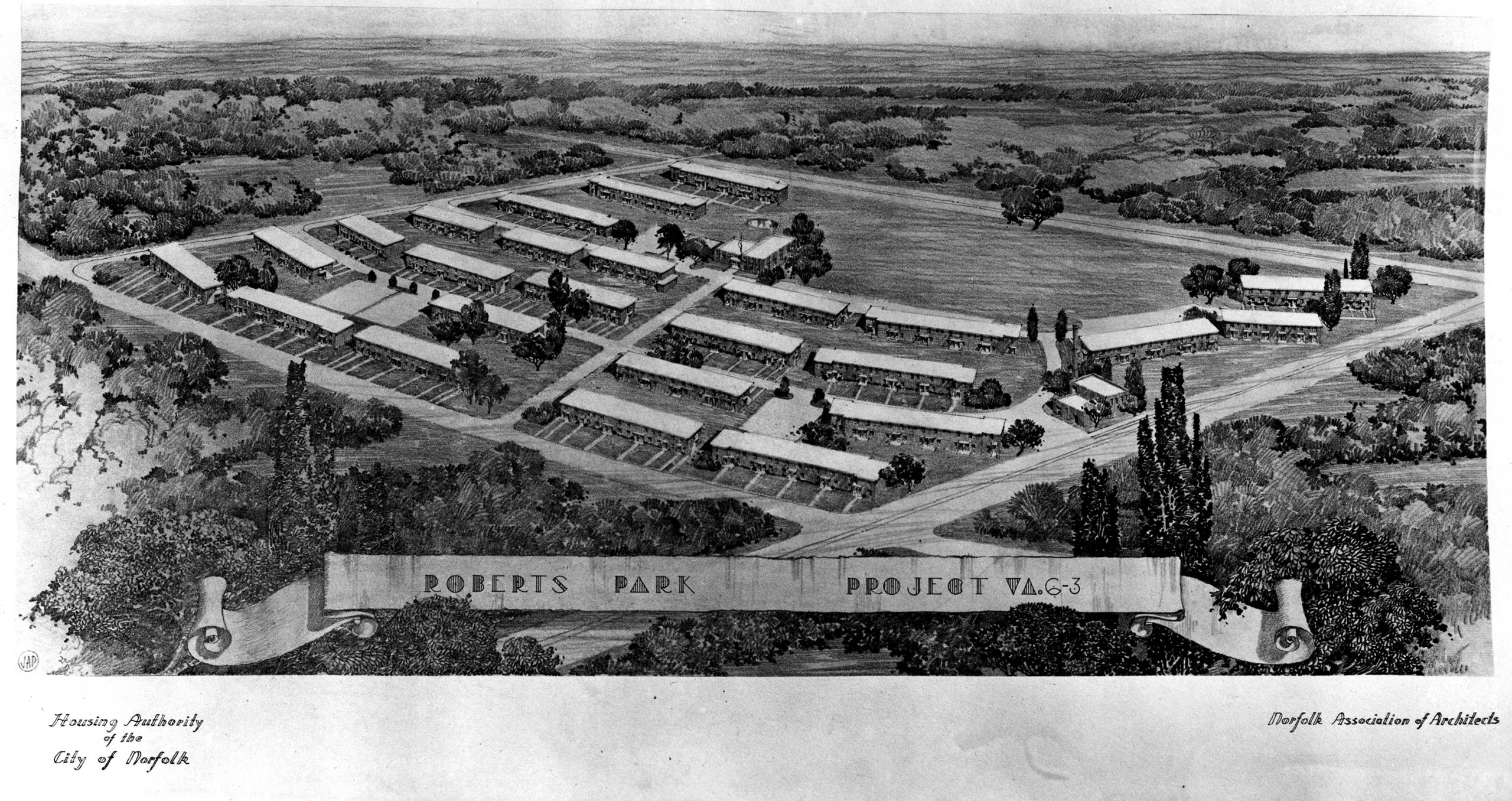
In the 1940s, as shipyards and military installations swelled with new workers and service members, the city rushed to construct housing developments to accommodate them. But like much of the United States at the time, Norfolk was segregated. The new parks and housing communities built during the war reflected those racial divisions. I hadn’t given much thought to how these communities were named, until I opened the first page of the Roberts Park Journal while researching another World War II collection.

Joseph Jenkins Roberts, half-length portrait, full face.
Library of Congress Prints and Photographs Division Washington, D.C.

Roberts Park Journal. Norfolk, Virginia: Roberts Park Housing Project, 1943.
Roberts Park, built during World War II to house Black families in segregated Norfolk, was named for a man born in the same city more than a century earlier who would go on to become the first president of an independent African republic.
Discovering that Roberts Park was named in his honor adds another layer of meaning. In a city where Black residents faced housing discrimination and limited opportunities, naming a wartime housing project after an internationally respected Black statesman was symbolic. Even over sixty years after his death, Joseph Jenkins Roberts remained an inspiration.

Moving day in Roberts Park housing in Broad Creek, September 1951.
Photocraftsmen Company. Courtesy of Sargeant Memorial Collection, Norfolk Public Library,
Joseph Jenkins Roberts was born on March 15, 1809, in Norfolk, Virginia, to free Black parents of mixed African and European ancestry. His family later moved to Petersburg, where he worked in his stepfather’s business and received much of his early education.
In 1829, at 20 years old, Roberts emigrated with his family to Liberia, a colony established by the American Colonization Society . There, he quickly established himself as a successful merchant in Monrovia and entered public life. He became the first Black governor of Liberia in 1841 and the first President of the independent Republic of Liberia in 1847.
As president, Roberts worked to secure Liberia’s sovereignty and diplomatic recognition, achieving formal recognition from Great Britain in 1849 and from other European nations soon after.
After serving two terms, he remained deeply involved in national development. He co-founded the University of Liberia in 1862 and served as its first president, raising funds internationally to support education in the young republic.
World War II housing records led me to a much bigger story from segregated Norfolk to the founding of a nation across the Atlantic.
I hope that in the future, Virginia’s curriculum and public memory continue to expand beyond the familiar narratives of founding fathers and major wars. Stories like that of Joseph Jenkins Roberts remind us that history is richer, more complex, and more interconnected than we often realize.
Header Image Citation
Roberts Park in Broad Creek, artist’s rendering, around 1948. Courtesy of Sargeant Memorial Collection, Norfolk Public Library, accessed: https://www.facebook.com/NorfolkPublicLibrary/photos/a.1199755193422745/1199907553407509/


