

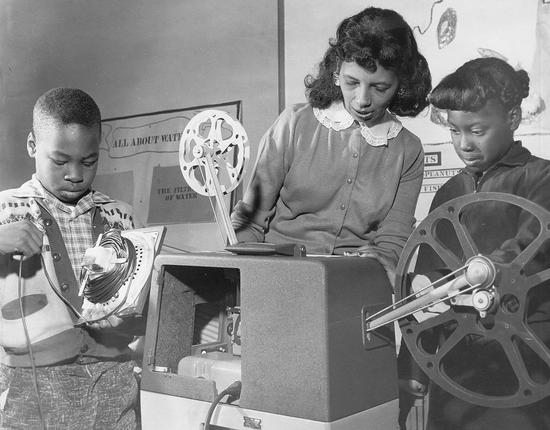
Decades before Netflix mailed its first DVDs, and even before you could ride your Huffy down to the local Blockbuster or Hollywood Video for a VHS, the Virginia State Library (now Library of Virginia) was providing Virginians with free access to movies and documentaries.
In today’s age of streaming whatever-you-want-wherever-you-want, it’s hard to remember that, in the not-so-distant-past, viewing options were more limited. Sure, older movies were often run on the three or four television channels as broadcast filler, and second-run theaters existed, but that content was hit or miss. Beginning in 1962, the Virginia State Library acquired 400 “cultural and educational” 16mm motion pictures that could be lent to public libraries for screenings by the local library branches, civic organizations, clubs, scout troops, or church groups.


By administrative agreement with the State Budget Office, the library lending program was prohibited from lending films to educational institutions such as day care centers, elementary or high schools, or colleges and universities in order to avoid duplicating the work of the Department of Education. The state library’s collection of films was to be built “with the clientele of the public library in mind.”
Searches of Virginia Chronicle turn up countless announcements for public library screenings around the commonwealth. Families were invited to gather at their local library for “Family Movie Nights” to watch films like Kon-Tiki or Beaver Valley, both from 1950. Many libraries, like Richmond Public Library, had special “Movies for Boys & Girls” events that screened titles like Roy, Sheep Dog of the Scottish Highlands (1958), Niok, The Orphan Elephant (1957), or Laurel & Hardy films. Other screenings were denoted as “Adult Film Night” and covered more mature content like Night and Fog, a film on the Holocaust, or Four Families, which compared family life in India, France, Japan, and Canada.
From its inception, the film-lending library proved quite popular. In its first year, the state library circulated 1,138 films. The number of titles available grew yearly and so did the requests. A catalog of available titles was published and distributed along with occasional supplements. By 1975, an increasingly strained staff of two circulated 18,000 films, which prompted the hiring of a third staff member.

Richmond Times Dispatch (Richmond, Virginia), February 1, 1965: 16.
NewsBank: America's News – Historical and Current.
The film program was not without controversy though. Just a year after its start, a public debate took place in Fairfax County after the local library screened the 1949 Julien Bryan film titled A Picture in Your Mind. Fundamentalist religious leaders, conservative legislators, and the American Legion charged that the film was “communist” and “degenerate” and should be banned. News articles from the time depict other citizens shouting down the complaints about the film at the screening. Those against such bans in public libraries also took to the editorial page to voice support for free expression.

Washington Evening Star, April 30, 1963.
Library of Congress.
A couple of decades later, another film library controversy exploded in the pages of the Richmond Times-Dispatch, this time involving titles like Alice in Wonderland and The Cat in the Hat. However, this hullabaloo wasn’t about the films themselves, but rather their acquisition.
Beginning in early February 1988, the Joint Legislative and Audit Review Commission (JLARC) began an investigation into a $61,000 (approximately $171,000 today) sole source contract between the Virginia State Library and Archives and Phoenix Films, Inc., allegedly brokered by then-State Librarian Ella Gaines Yates. Another contract covering electronic catalogs for public libraries was also scrutinized.
Over the next four months, news stories recounted criticisms from former employees and allegations of kickbacks (in the form of a fur coat) from Phoenix Films, Inc., allegations roundly denied by Ms. Yates. State Police investigators were eventually called in to initiate a criminal probe. Ultimately, State Librarian Yates was cleared of all charges, but cited in the final JLARC report for “errors in judgment and miscommunication [that] resulted in a perception by some library staff that the procurement was improper and perhaps illegal.”


The passage of time brought new formats to the collection. The film-lending library began adding video cassettes in the early 1990s. The lending program was still very popular with a catalog of nearly 4,000 films and videos. It served over half a million Virginians in 1992.
Unfortunately, budgets rather than popularity determine longevity in state government. The 1992-1993 state budget cut $600,000 from the Virginia State Library and Archives, and to make up for some of that shortfall, State Librarian John C. Tyson announced the elimination of the film and video lending library. The program officially ended July 1, 1992, 30 years after its establishment.
Some of the VHS cassettes from the lending library went into the state library’s general collection, while some 16mm films went to public libraries around the state as a permanent loan. Some of the 16mm films maintained by Library of Virginia can be found on our YouTube State Government Records Collection playlist.
In some public libraries around the country, 8mm and 16mm films have had a bit of a comeback. The Miami-Dade Public Library has an AV Club that screens short films from the library’s extensive collection. The New York Public Library’s Reserve Film and Video Collection is open to researchers and titles are shown as part of its Little Screen program. Many Virginia libraries, including the Library of Virginia, screen movies and documentaries (just not the old school projector-type), so you can still go to a library and watch interesting films with your fellow citizens.
Header Image Citation
Walker, Jimmy, and Portsmouth Public Library. Esther Murdaugh Wilson Memorial Room. A Picture Is Worth 10,000 Words, 1957. http://image.lva.virginia.gov/VDLP/POR/ROD/images/00615.jpg.


