

One hundred years ago this month, Dr. Carter G. Woodson established Negro History Week which, decades later, became Black History Month. Since 1968, February has been nationally recognized as Black History Month offering us an opportunity to reflect, recognize, and learn more about the Black experience.
In my neck of the woods (read: Library) I spend a great deal of time thinking about all the work that remains around sharing our complicated past. I examine records every week that I wish were digitized or easier to find. Fragments of our history remain scattered across collections, attics, and archives in Virginia and beyond. What material do we prioritize for physical and digital preservation and access? And how do we connect more people with our resources? How do we facilitate meaningful conversation around these complex stories? I don’t have all the answers! But since it’s Black History Month, I recognize an opportunity to reflect on how some of this challenging work is progressing.
A few years ago, I began using Google Analytics (GA4) to measure traffic to the Virginia Untold website. This past year in 2025, GA4 tracked 51,682 sessions in Virginia Untold. The previous year in 2024, there were only 11,889 sessions. Sessions track how many people visit our site, or in other words, walk into our Virginia Untold “store.” Sessions are interesting, but engaged sessions tell us more. This metric measures people who stay on our site longer or view two or more pages and it filters out users who click on our site and immediately leave. To continue the “store” metaphor, engaged sessions represent users who walk into our Virginia Untold store and browse records or click on a link. This past year in 2025, GA4 tracked 14,559 engaged sessions. In 2024 the site only had 8,000 engaged sessions. That’s a nearly 82% increase for engaged sessions from 2024 to 2025.

An example of the storage shelving in the Washington County Circuit Court records room--just one of a few places I searched for the ``Register of Free Negroes.``
In other words, we have nearly doubled the amount of people visiting the site and engaging with these documents for research, genealogy, and learning.
This past year we made 129 new records digitally available in Virginia Untold including twelve new “Free Negro Registers” representing ten different Virginia localities and thousands of names of free Black Virginians. We added fully searchable transcriptions to 319 records, partnered with four new circuit court localities, and accessioned 53 gigabytes of data from historic registers into our collections.


That’s just the numbers. The qualitative data is a bit more compelling. Just a few weeks ago a high school student emailed me to learn more about a record in Virginia Untold of a free Black man who petitioned to be re-enslaved. I’ve been working with the student to analyze the document and put context around why a free Black person might choose this route. She’s decided to use this record to complete her final project for her AP African American Studies class. I’ve also been in contact with a graduate student who is completing their dissertation using criminal records in Virginia Untold that accuse people of forging freedom certificates—for themselves and for their communities. Last spring Virginia Humanities Fellow Tev’n Powers built a data visualization site using datasets of enslaved fugitives from the Runaway Records in Virginia Untold. Seventy-three people attended his virtual lecture. Last June, we celebrated at a new Juneteenth ceremony in Colonial Beach meeting over 60 attendees and sharing about the Library’s resources. This semester, Virginia Humanities Fellow Michelle Oliver is in residence at the Library using various collection material to research enslaved life insurance and industrial labor in antebellum Virginia.
In January, I learned about a new museum in New York, The Huntington African American Museum. Their chief curator contacted the Library about records in Virginia Untold related to Accomack County free man Peter Crippen, who moved to New York after emancipation and became the town’s patriarch. We’ve shared reproduction manuscript material for their upcoming exhibition in June (I hope to write about Crippen’s story in an upcoming blog!). These are just some of the projects I know about!
Many of us understand that Black experience in Virginia expands far beyond slavery. Our current exhibition, “House to Highway: Reclaiming a Community History,” featuring the historic Black Richmond neighborhood Jackson Ward, had 7,379 visitors from our opening in July 2025 through the end of January 2026. We hosted a reception in July to celebrate the opening which welcomed 300 people. Several months later in October, we hosted a day-long symposium around the exhibition with 124 participants. Over the course of the following months, 720 people have joined us for book talks, documentary film screenings, and programs that centered on Black and other marginalized communities who have faced urban renewal. And did you know? — Public school students will also be learning this history in their Virginia classrooms beginning this school year. New standards for the Virginia SOLs have gone into effect for the 2025–2026 school year; they were designed to teach new content such as the consequences of 20th-century policy, like urban renewal.1


We tabled at two different Juneteenth events this past June sharing resources about Black history from the Library of Virginia—one in Henrico County’s Dorey Park and one in Colonial Beach, Virginia.
Most days it feels difficult to “celebrate”, but I think we can still take a moment to pause and see where we’ve come. Instead of one week to honor Black life and culture, we have entire projects, education courses, exhibitions, and museums dedicated to preserving and sharing Black history. To be clear, we have a long way to go, but the work continues and the people doing that work persist. There may only be four days left in Black History Month this year, but there is a lifetime awaiting us to keep telling these stories.
Footnotes
- Charles B. Pyle, “Board of Education Approves 2023 History and Social Science Standards of Learning,” media release, April 20, 2023, https://www.doe.virginia.gov/Home/Components/News/News/288/227.
Header Image Citation
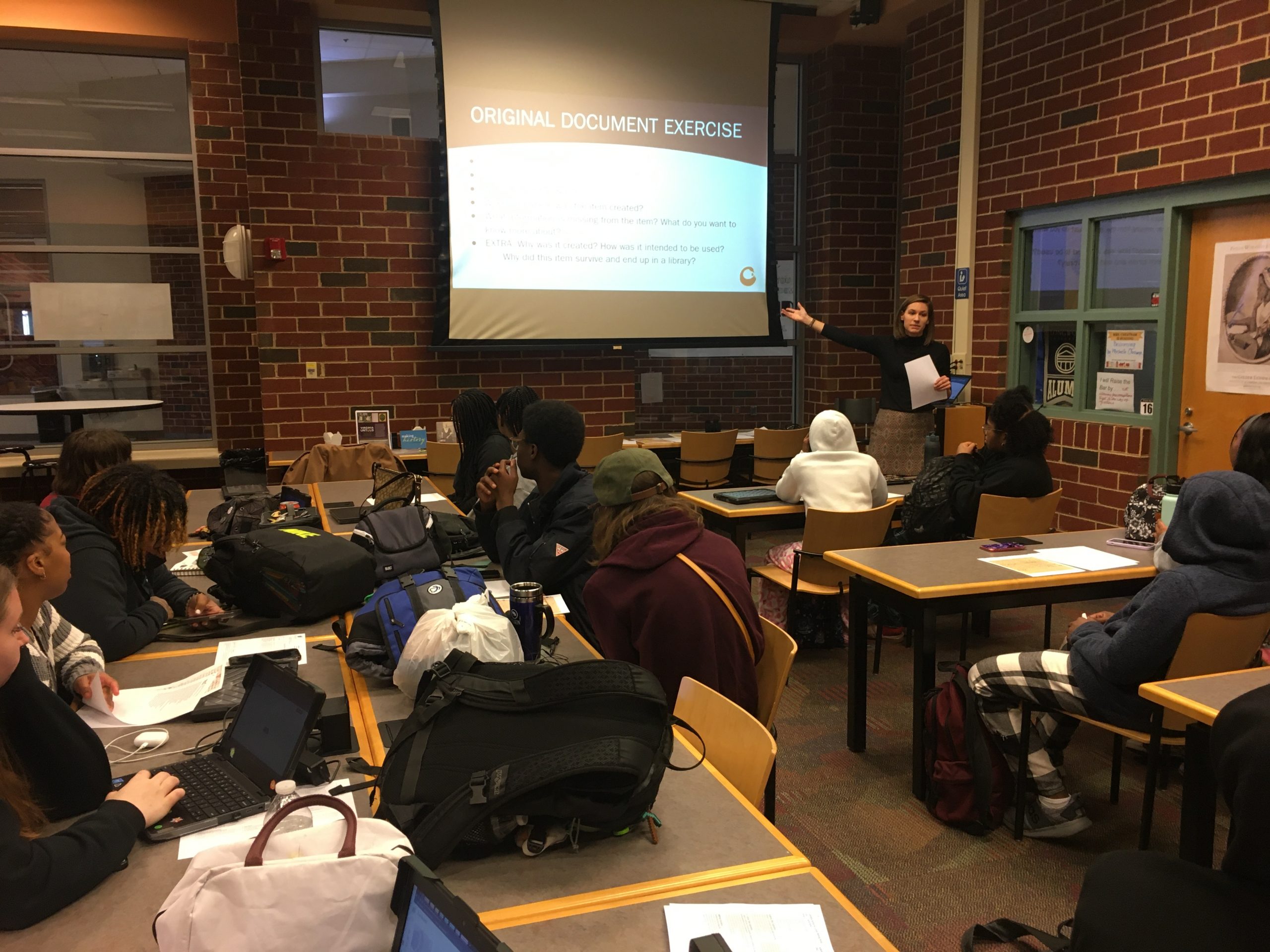
Primary source literacy using Virginia Untold records at Matoaca High School, February 2023


