

February 2026 marks the centennial of the first Negro History Week, established by Carter Godwin Woodson. The son of formerly enslaved parents, Woodson was born in the Buckingham County community of New Canton on December 19, 1875. He began his education in a one-room segregated schoolhouse while also working as a farm laborer. As a young man he sought better pay in the coal mines of West Virginia, where his brothers had gone to work in Fayette County.
In 1897 he graduated from segregated Frederick Douglass High School in Huntington, West Virginia, having taken only two years to complete his degree. While working as a high school principal and teacher, Woodson earned his BA in 1903 from Berea College, in Kentucky, the first integrated coeducational college in the South. He went on to earn an MA in European history from the University of Chicago in 1908 and a PhD in history from Harvard University in 1912, with a dissertation, “The Disruption of Virginia,” focusing on the class and economic differences between eastern and western residents—rather than the issue of slavery—that spurred the creation of West Virginia in 1863.

Photo of Woodson on cover of Negro History Bulletin (May 1950).
While teaching high school in Washington, D.C., Woodson worked to elevate scholarship of Black historians who were shut out of the white-dominated academic associations. In 1915 he founded the Association for the Study of Negro Life and History (now the Association for the Study of African American Life and History). The following year he began publishing the Journal of Negro History (now the Journal of African American History), and in 1921 he established Associated Publishers as an avenue for the work of Black scholars to be disseminated.

Richmond News Leader, February 07, 1927.
The author of more than a dozen books, Woodson published The Negro in Our History (1922), which became a seminal work in defining Black life and African Americans’ contributions to United States history. Underscoring his influence in Virginia and across the nation, commentaries, reviews, and articles about the work Carter directed at the Association for the Study of Negro Life in History appeared in Black-owned newspapers, such as the Richmond Planet. His writings on African American education, achievements, and civil rights often appeared in the pages of the Southern Workman, a journal published by Hampton Institute (later Hampton University).
Woodson announced that the first Negro History Week would be recognized during the second week of February 1926. He chose that week because for many years Black Americans had been celebrating President Abraham Lincoln’s February 12 birthday as well as civil rights activist Frederick Douglass’s chosen birth date of February 14. Woodson called for community celebrations and urged African Americans to request that local school boards adopt textbooks documenting Black history and to share their family and local histories with the Association for the Study of Negro Life and History (ASNLH) to preserve it for future generations. He stressed that white Americans “cannot learn their own history unless they include that of the Negro,” which required “an unbiased history of the whole.”1
Negro History Week’s popularity spread rapidly and by the 1960s some communities were celebrating Black history for the entire month. In 1975, Gerald Ford was the first U.S. president to issue a message acknowledging Black History Week and urging all Americans to recognize its significance. During the nation’s bicentennial the following year, the ASNLH expanded the celebration into Black History Month. Congress approved an act in 1986 designating February as National Black (Afro-American) History Month, which has been recognized with presidential proclamations since 1996.
In Virginia, African American community organizations, literary clubs, churches, and schools embraced Negro History Week and held concerts, plays, public lectures, and other events around the commonwealth. In 1927, Carter Woodson spoke at Richmond’s Armstrong High School as part of the observance of the second Negro History Week. Virginia newspapers reported on Negro History Week programs and celebrations, to which Black Virginians invited white Virginians to experience and learn about the achievements and contributions of Black men and women to the history and culture of the United States and the world. Shortly after taking office in 1970, Governor Linwood Holton directed Virginians to observe Negro History Week as an integral part of “the history of America” that includes “every American regardless of race, color or creed.”2 Since the 1980s, Virginia’s governors have regularly recognized February as African American History Month.

Ashland Herald-Progress, February 09, 1933.
Since 2007, the Library of Virginia has honored Black Virginians of the past and present as part of our annual African American Trailblazers program, which joined with Dominion Energy to become Strong Men & Women in Virginia History in 2013. Learn more about these distinguished Virginians in Virginia Changemakers.
Widely referred to as the “Father of Black History,” Woodson died in Washington, D.C., on April 3, 1950. Many schools across the country are named for Woodson, including a high school in Fairfax and a middle school in Hopewell. A Virginia state historic marker was dedicated near his Buckingham County birthplace in 1976, and other memorials have been erected nearby. The University of Virginia’s Carter G. Woodson Institute has advanced African American and African Studies around the world by transforming academia, training scholars, and educating the public about issues of race, social justice, and inequality.
Footnotes
[1] Norfolk Journal and Guide, Dec. 5, 1925.
[2] Richmond Times-Dispatch, Feb. 7, 1970. State senator L. Douglas Wilder described Holton’s directive as the first from a Virginia governor recognizing Black History Week (Northern Virginia Sun, Feb. 11, 1970).
Header Image Citation
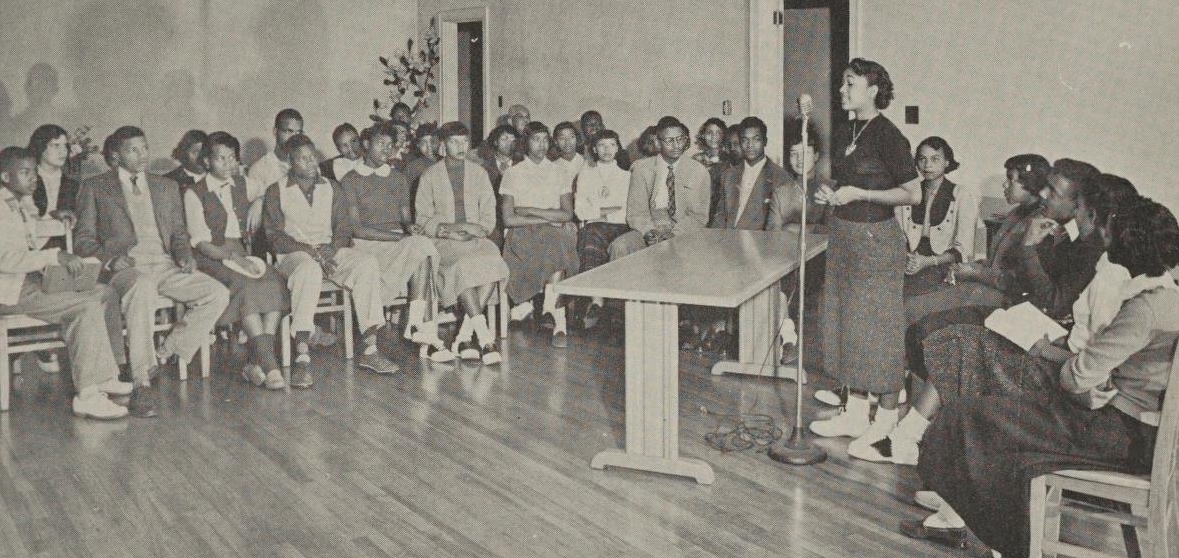
Caption: The Negro History Club was founded in 1948, and was named for the late Luther P. Jackson, professor of History at Virginia State College. The purpose of the club is to make the students aware of the accomplishments of the Negro race on a local, state, and national and international level with the hope that it will develop a sense of race pride in them. The officers of the club are; President, Robert Penick; Vice President, Frances Abrams; Secretary, June Parrish; Assistant Secretary, Rosa York; Treasurer, Blanche Smith; Sponsor, H. S. Ferguson.
The above photo is a scene from the club’s annual Negro History Week Broadcast.


